
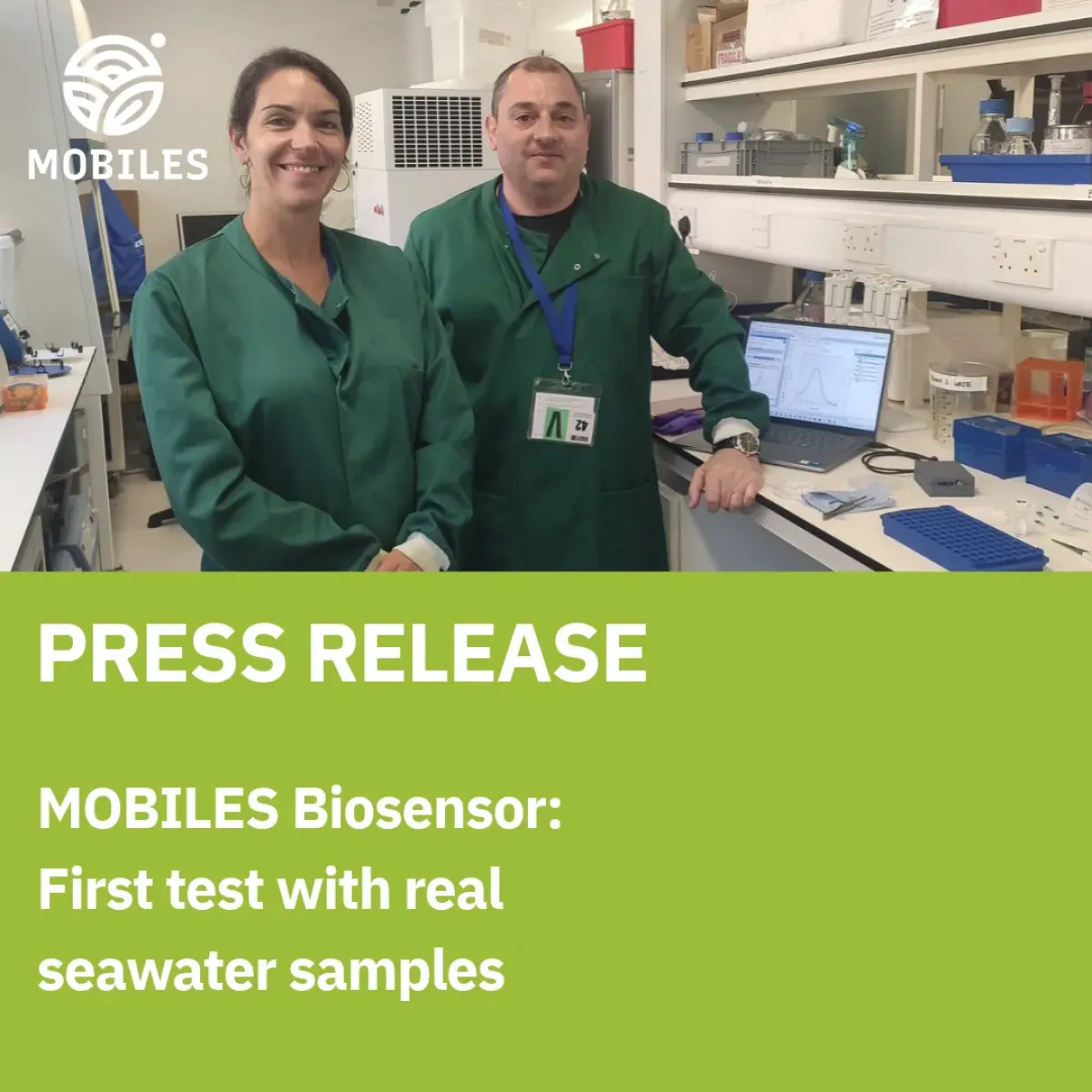
An opportunity provided by the collaboration with the AquaBioSens project enabled MOBILES researchers to test their biosensor and portable reader with real seawater samples for the first time. The team reported qualitative detection of estradiol, marking an important step towards the project’s ambition of bringing pollution monitoring closer to sampling locations.
The EU-funded project MOBILES has reached a development milestone: its estradiol biosensor, coupled to a portable electronic reader, has undergone its first test with real environmental water samples. Developed for freshwater applications, the system was tested with seawater collected in Southampton Bay during the AquaBioSens annual meeting on 6–8 July 2026. The team reported detection of estradiol without adding the hormone to the samples.
The opportunity arose through collaboration with AquaBioSens, whose meeting combined scientific exchange with a programme of marine technology trials. Access to seawater samples collected by Professor Nic Bury (AquaBioSens team) aboard a University of Southampton research vessel allowed MOBILES researchers to take the system beyond the controlled solutions used during development. Although seawater was not its intended testing environment, the team used the opportunity to explore its response in a real and chemically different sample.
The meeting was hosted by the National Oceanography Centre and organised by Jonathan McQuillan and Professor Nic Bury, with AquaBioSens coordinated by Martha Valiadi of the Foundation for Research and Technology–Hellas.
This first real-sample test brought the biosensor and portable reader into a new stage of development. Environmental samples contain substances that can influence sensor responses, making their analysis an essential step towards practical monitoring applications.
The result was qualitative: the team reported identifying estradiol’s presence, but did not measure its concentration. Further work will establish a seawater calibration curve and test samples containing known additions of estradiol. These steps will help determine whether the initial detection can be developed into quantitative seawater analysis.
Estradiol, also known as 17-β-estradiol or E2, is a naturally occurring hormone produced by mammals, including humans. Estradiol is often prescribed for hormone-based therapies, and its increasing consumption as a medicinal product has resulted in enhanced environmental discharge and accumulation. Through human and animal excretion, it can enter aquatic environments via wastewater discharges and agricultural runoff. Wastewater treatment does not always remove hormones like estradiol completely, allowing biologically active compounds to reach receiving waters.
Its natural origin does not make its environmental presence harmless. Estradiol can interfere with hormonal signalling in aquatic organisms even at very low concentrations, affecting reproductive development and function. Indeed, estradiol and other drug-like contaminants, including synthetic hormones, anti-inflammatory drugs, antibiotics, antidepressants, antimicrobial agents, and sunscreen-derived compounds, are listed by the European Union among chemicals of emerging concern because of their potential risks for both ecosystems and human health. Monitoring therefore requires methods capable of distinguishing small amounts of the hormone within complex samples containing salts, organic matter and other substances.
Established laboratory techniques, including chromatography coupled with mass spectrometry, provide sensitive analysis. However, specialised equipment, trained personnel and sample preparation can make extensive monitoring costly and logistically demanding. Transporting samples to laboratories also adds time between collection and the availability of results. Portable biosensors could complement these methods by bringing initial assessment closer to sampling locations. Once appropriately validated, such tools could help researchers and environmental monitoring teams examine more locations or test more frequently, while laboratory methods provide detailed or confirmatory analysis.
This specific biosensor uses short synthetic DNA strands called aptamers, selected for their ability to bind estradiol. Attached to a gold electrode, they form a biological recognition layer. Binding of the target changes the electrode’s electrochemical response, which is recorded by an electronic reader.
The National Technical University of Athens (NTUA) team developed a portable readout platform to work with the project’s electrochemical biosensors. The reader connects to a computer through USB, allowing researchers to control measurements, view responses and export data. Both the reader and the estradiol biosensor were used in the seawater trial.
Developing the sensing element and its readout together is an important part of turning a laboratory sensing approach into a practical monitoring tool. Tests with real samples allow the team to investigate how the combination performs when exposed to the complexity of environmental water.
The estradiol biosensor is one element of MOBILES’ broader effort to develop rapid, portable and affordable tools for detecting chemical and biological pollution. Coordinated by NTUA, the project combines electrochemical devices with research into organism-based biosensors, including marine diatoms and genetically modified bacteria and plants.
Alongside detection performance, MOBILES addresses the practical and environmental implications of these technologies. Work on packaging, storage and protective materials aims to preserve sensor function and extend their usable lifetime. Researchers are investigating coatings made from biodegradable materials for protecting electrochemical electrodes. Development of miniaturised and microfluidic systems also aims to reduce the sample and reagent volumes needed for analysis. For genetically modified organisms developed as biosensors, the project includes containment measures and assessments of potential environmental risks and effects on non-target organisms. These activities form part of a development strategy that considers how monitoring tools perform, how they can be used responsibly and what environmental impacts they may have.
MOBILES also analyses microbial communities in polluted soils to identify genes associated with contamination. Together, these strands connect the development of detection tools with a deeper understanding of pollution and its biological effect.
MOBILES Press Release n.2

