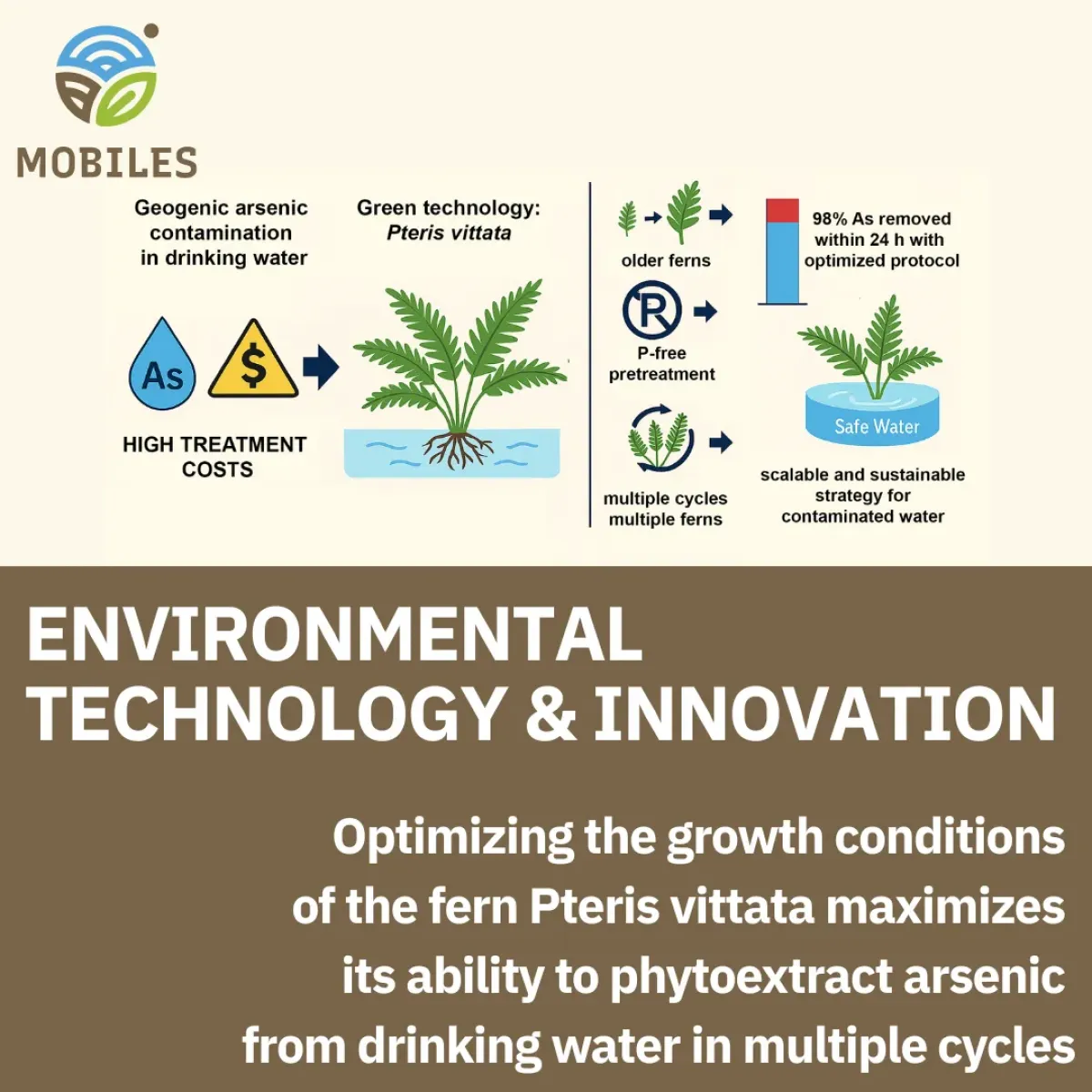
What if a simple plant could remove toxic arsenic from water faster and cheaper than expensive filtration systems? Scientists from the MOBILES project show that this could be true by exploiting the Chinese brake fern (Pteris vittata).
Arsenic contamination is a serious problem worldwide, affecting both soil and
water and posing major health risks. Traditional filtration methods, like
chemical treatment or membranes, are costly and often inaccessible. That’s
where P. vittata comes in. This fern is a natural “hyperaccumulator”
able to absorb large amounts of arsenic and store it safely in its fronds.
Recent research has optimized the conditions under which P. vittata
works best. Scientists found that large older ferns remove arsenic faster than
younger ones, and pre-treating them with a phosphorus-free solution
significantly boosts uptake even further. Remarkably, a single fern can remove
almost all arsenic from contaminated spring water in just one day, reducing
arsenic concentration from 60 to 2 µg L-1, far below the legal
limit of 10 µg
L-1 for arsenic in drinking water.
Even better, ferns can be reused in multiple cycles, maintaining high
efficiency and making the process more cost-effective. Using several ferns
together in the same tank also works well, paving the way for large-scale
applications.
This plant-based approach represents a promising, sustainable alternative to
expensive filtration systems, offering a greener solution to the global
challenge of arsenic-contaminated water. While safe disposal of arsenic-rich
fronds remains a challenge, their roots contain low arsenic and can be
repurposed for materials production. With further research, P. vittata
could become a key tool in making clean drinking water accessible worldwide.
Optimizing the growth conditions of the fern Pteris vittata maximizes its ability to phytoextract arsenic from drinking water in multiple cycles
Authors: Maria Luisa Antenozio, Davide Marzi, Clara Sette, Lorenzo Massimi, Alice Zara, Enrico Veschetti, Luca Lucentini, Maura Cardarelli, Patrizia Brunetti
Full publication here