
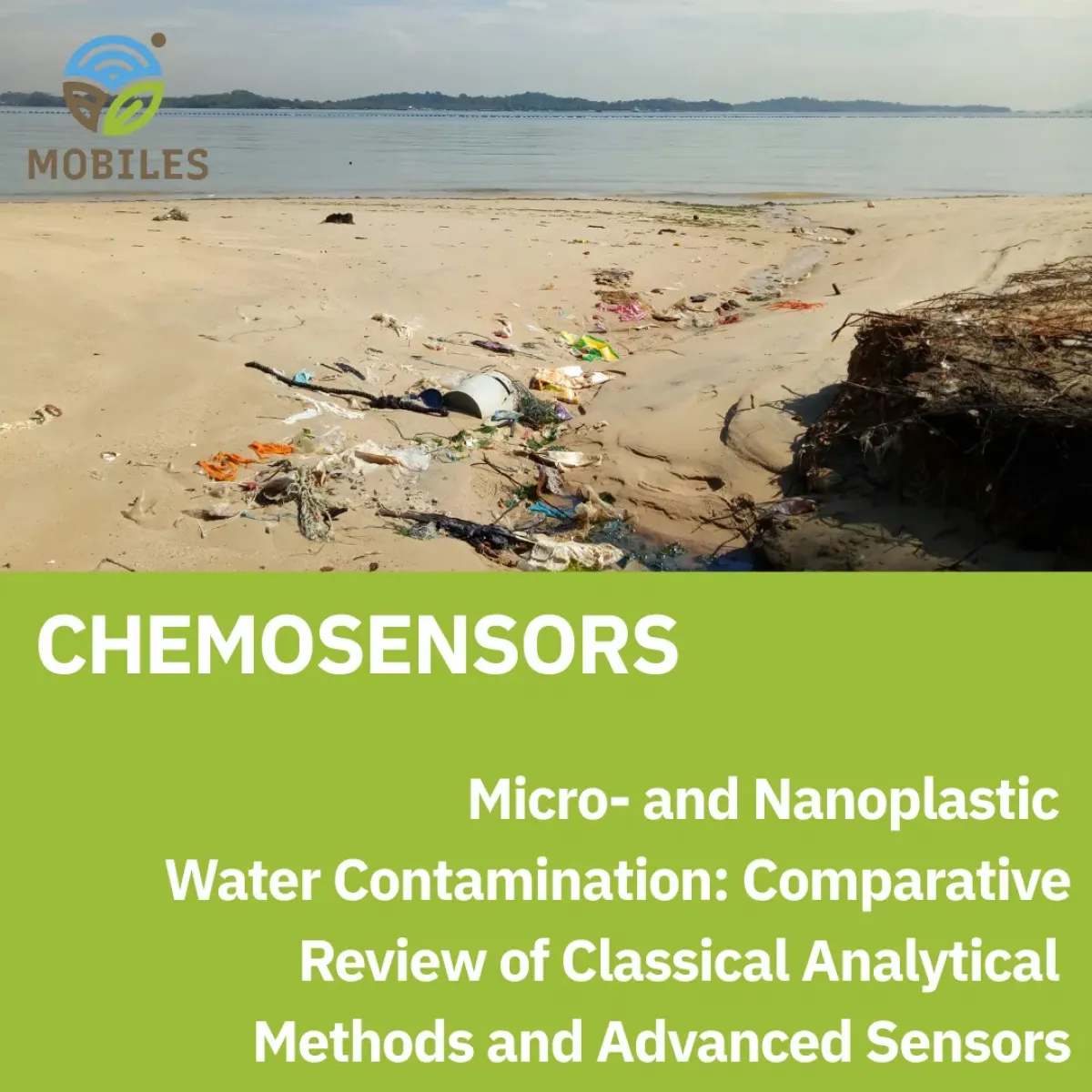
Micro- and nanoplastics have become a growing concern for aquatic ecosystems and water quality. Their persistence, widespread distribution and ability to interact with other environmental contaminants make them particularly challenging to monitor. Yet, despite considerable advances in analytical technologies, accurately detecting these particles, especially at the nanoscale, remains far from straightforward.
A new systematic review published in Chemosensors, co-authored by researchers from INRAE, examines how established analytical methods compare with emerging sensor technologies for detecting micro- and nanoplastics in water. Drawing on 53 original research studies published between 2021 and mid-2026, the review evaluates recent developments in detection capabilities, technological limitations and the prospects for translating laboratory advances into practical environmental monitoring.
One of the most revealing findings of the review is that approximately 70% of water-based studies relied on laboratory-spiked or unspecified samples rather than clearly identified environmental waters. This distinction matters because the conditions under which a sensor performs well in the laboratory may differ considerably from those encountered in rivers, lakes or coastal waters.
Natural water samples contain dissolved organic matter, suspended particles, salts and other substances that can interfere with analytical measurements. Micro- and nanoplastics themselves are equally diverse, varying in polymer composition, size, shape and degree of weathering. As a result, methods optimised for uniform plastic particles under controlled conditions may struggle to deliver the same sensitivity and reliability when confronted with environmental samples.
This is particularly challenging for nanoplastics, whose extremely small dimensions complicate their isolation, identification and quantification. Improving analytical sensitivity is therefore only part of the solution. Equally important is understanding how detection methods perform when plastic particles are present alongside the many other constituents of natural waters.
The review examines how both established analytical techniques and emerging sensor technologies are responding to these challenges. Spectroscopic methods such as FTIR and Raman spectroscopy remain essential for identifying plastic polymers, but their dependence on specialised instrumentation and sample preparation can limit their use for frequent monitoring. Newer optical, electrochemical and biological sensing approaches are being investigated as potentially faster and more accessible alternatives.
Among these, biosensors offer an interesting direction by incorporating biological recognition elements or responses into the detection process. Although still at an earlier stage of development, they could eventually complement conventional laboratory analysis through rapid screening applications.
The significance of these developments extends beyond making individual measurements faster or more convenient. Environmental contamination is not static. Plastic particles can enter aquatic environments through wastewater discharges, surface runoff and other pathways, while their distribution changes with water movement and environmental conditions.
Conventional monitoring generally relies on samples collected at selected locations and analysed in specialised laboratories. Although these methods provide valuable information about plastic contamination, they are less suited to capturing short-term changes or supporting frequent measurements across larger monitoring networks.
This is where emerging sensor technologies could make an important difference. Portable and potentially lower-cost systems may eventually allow researchers and environmental authorities to monitor contamination more frequently, identify changes earlier and select samples requiring more detailed laboratory analysis. Such approaches would not necessarily replace established analytical techniques but could complement them, making environmental monitoring more responsive and accessible.
However, translating this potential into practical applications requires more than miniaturising existing technologies. Sensors must demonstrate sufficient selectivity, reproducibility and stability under realistic environmental conditions. The review also highlights the need for more consistent analytical protocols, as differences in sample preparation, particle classification and reporting practices currently complicate comparisons between studies. Without greater methodological harmonisation, even highly sensitive technologies may struggle to provide the comparable data needed for long-term environmental assessment.
The challenges identified in the review also resonate with ongoing research within the MOBILES project. Researchers from the Cyprus University of Technology are exploring the use of marine diatoms as living biosensors for micro- and nanoplastic detection, investigating a biologically based approach that could complement established analytical methods. This work illustrates one possible route towards simpler and potentially more accessible environmental monitoring.
Related article: Turning Marine Microalgae into Early-Warning Sensors
By identifying both technological advances and persistent methodological gaps, the review highlights where further research is needed to make micro- and nanoplastic monitoring more reliable and accessible. Progress in this field could ultimately provide researchers and environmental authorities with a clearer picture of plastic contamination in aquatic ecosystems, supporting more informed decisions on pollution prevention and environmental protection.
Micro- and Nanoplastic Water Contamination: Comparative Review of Classical Analytical Methods and Advanced Sensors
Authors: Brankica Kartalovic, Jasmina Vidic
Full publication here

