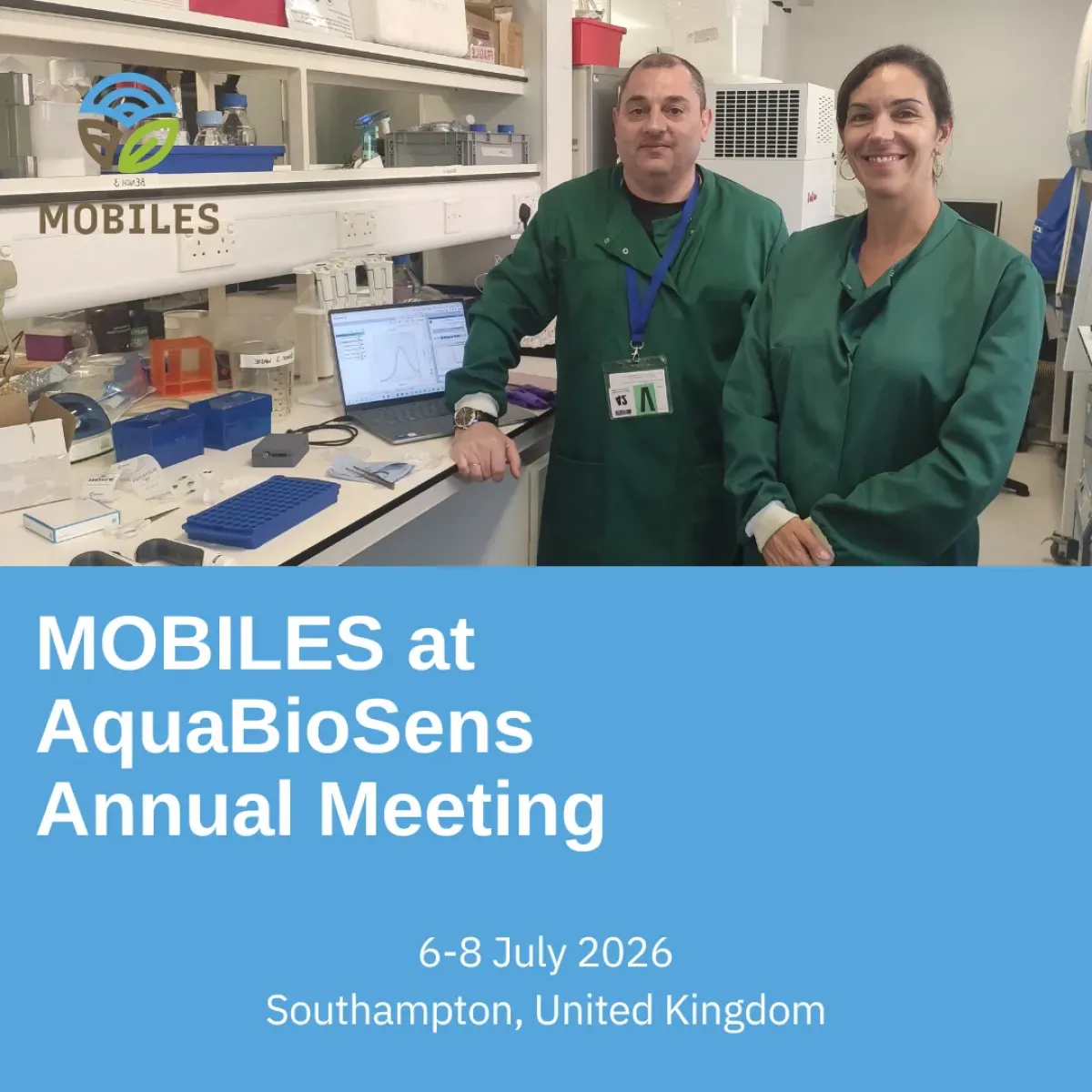
From 6–8 July, the MOBILES project took part in the AquaBioSens Annual Meeting, hosted by the National Oceanography Centre in Southampton, UK. The three-day event combined consortium discussions, technology demonstrations and field testing, creating an excellent setting for exchanging experience between European projects working on innovative environmental monitoring technologies.
MOBILES was represented by Angelo Ferraro and Giuseppe Diego Puglia, who presented progress from WP1 and WP3. Their presentations covered the development of electrochemical biosensing approaches for estradiol detection in water and the use of soil microbiomes as indicators of emerging contaminants.
A highlight of the meeting was the field-testing campaign in Southampton Bay. Sea water samples collected by the AquaBioSens team aboard a University of Southampton research vessel were used to evaluate several sensing technologies under real environmental conditions. During these trials, the MOBILES estradiol biosensor successfully detected estradiol in the collected samples. Although the sensor had originally been developed and optimised for freshwater applications, it also performed well in seawater, demonstrating encouraging robustness and opening new perspectives for future validation activities.
Beyond the technical demonstrations, the meeting provided valuable opportunities to discuss implementation challenges, compare technological approaches and identify areas for future collaboration between the two projects. The exchange highlighted the complementary expertise within the European biosensing community and the benefits of bringing together projects addressing different aspects of water quality monitoring.
MOBILES would like to thank Martha Valiadi (FORTH), coordinator of AquaBioSens, as well as Professor Nic Bury (University of Southampton) and Jonathan McQuillan (National Oceanography Centre) for their warm welcome and for organising such a productive meeting. Collaborations such as this help strengthen connections across European research initiatives and accelerate the development of innovative biosensor platforms for environmental monitoring.