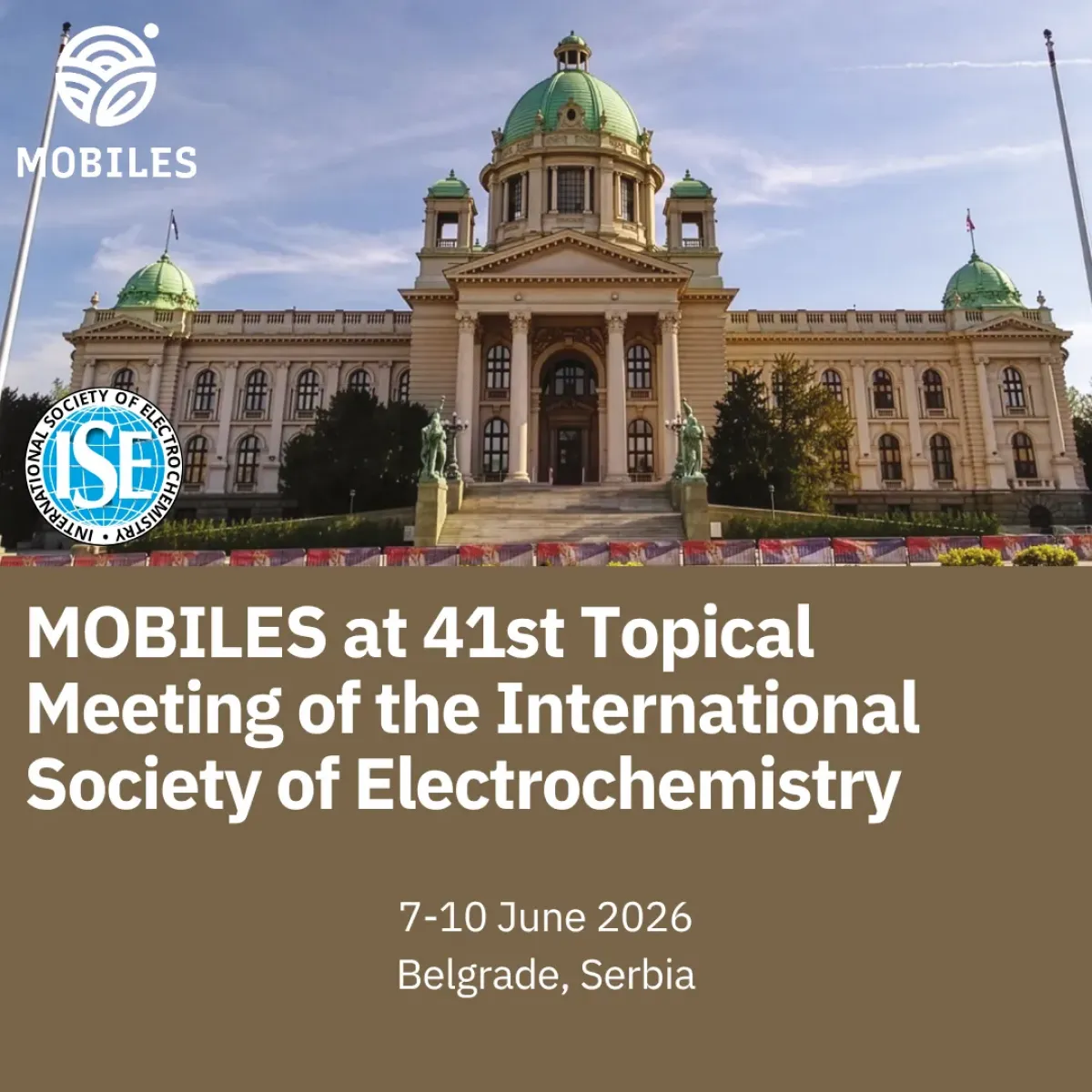
The MOBILES consortium would like to announce its scientific presence at the 41st Topical Meeting of the International Society of Electrochemistry (ISE), where project partners will present cutting‑edge research advancing next‑generation biosensing technologies. With five contributions, spanning keynote and invited lectures, and posters, the project showcases how electrochemistry, photochemistry, and environmental diagnostics converge to support Europe’s zero‑pollution ambition.
New Mechanistic Pathways and the Role of Electrode Material for the Enhancement of Electrochemiluminescence Biosensing
Neso Sojic, University of Bordeaux
Electrochemiluminescence (ECL), a process in which light is generated through electrochemical reactions without external illumination, has evolved from a scientific curiosity into a powerful analytical tool. Its exceptionally low background signal makes it indispensable for clinical diagnostics, ultrasensitive detection, and imaging.
In his keynote lecture, Prof. Neso Sojic will discuss how newly uncovered mechanistic pathways can significantly enhance ECL sensitivity, particularly in immunoassays. He will also highlight the crucial influence of electrode materials on reaction efficiency and signal amplification. The presentation further introduces photoinduced ECL (PECL), a concept that merges ECL with photoelectrochemistry at illuminated semiconductor electrodes. By converting absorbed photons into ECL emission, PECL opens new possibilities for light conversion, biosensing, and catalytic imaging, illustrating the versatility and future potential of ECL‑based technologies.
Electrochemistry at the Fingertips: Glove‑Based Screen‑Printed Flexible Nanocomposite Electrodes for Wearable Sensing of Pesticides
Dalibor Stanković, University of Belgrade
The increasing global demand for agricultural production has intensified pesticide use, raising concerns about human exposure and environmental contamination. Persistent residues in soil, water, food, and air underscore the need for rapid, accessible, and field‑ready monitoring tools.
Dr. Dalibor Stanković will present a novel wearable electrochemical platform that brings sensing capabilities directly to the fingertips. By screen‑printing flexible nanocomposite electrodes onto disposable gloves, the team created a robust, mechanically resilient system capable of performing on‑site pesticide detection through direct contact with real samples. The nanocomposite‑modified electrodes ensure efficient electron transfer and stable redox behaviour, even during finger movement. This approach aligns with principles of green electrochemistry, reducing material use and eliminating the need for rigid substrates or complex assembly. The resulting glove‑integrated sensor represents a practical, low‑waste solution for point‑of‑use environmental monitoring.
Alongside the keynote and oral presentation, MOBILES partners will present three posters showcasing emerging electrochemical sensing platforms designed for rapid, sensitive detection of biological and chemical contaminants. These contributions highlight how functional nanomaterials and smart electrode architectures can support next‑generation monitoring tools aligned with the project’s zero‑pollution mission.
Detection of Bacillus cereus Spores Using a Label‑Free Aptasensor
A poster by Aleksandar Mijajlović focus on development of a label‑free electrochemical aptasensor based on a reduced graphene oxide/La₂O₃‑modified screen‑printed electrode. By integrating tailored nanomaterials with a specific aptamer, the platform enables selective and practical detection of B. cereus spores, a key food safety concern. The approach demonstrates strong potential for rapid microbial monitoring in real samples.
Pr₂O₃@MWCNT Nanocomposite Sensor for Carbendazim Monitoring
In work presented by Tijana Mutić, a praseodymium oxide–carbon nanotube nanocomposite was synthesized via a simple hydrothermal route and applied as an electrode modifier for detecting the fungicide carbendazim. The resulting sensor shows enhanced electrocatalytic activity, wide linear range, and high sensitivity, offering a cost‑effective tool for monitoring pesticide residues in environmental and agricultural matrices.
Co‑Functionalized g‑C₃N₄ Nanosheets for Honokiol Detection
A poster presented by Dalibor Stanković introduces a Co‑modified graphitic carbon nitride nanosheet sensor for the bioactive compound honokiol. The synergistic interaction between cobalt species and g‑C₃N₄ significantly improves electron transfer, enabling sensitive, selective, and stable detection across a broad concentration range. The platform demonstrates strong applicability for quality control of plant‑derived products.
Together, these posters illustrate the breadth of electrochemical innovation within MOBILES, from microbial biosensing to pesticide and bioactive compound detection, reinforcing the consortium’s commitment to developing robust, scalable, and environmentally relevant sensing technologies.
The participation of MOBILES partners at the ISE Topical Meeting highlights the consortium’s commitment to advancing electrochemical and photoelectrochemical sensing technologies that support safer environments and improved contaminant monitoring. We warmly invite conference attendees to visit the MOBILES presentations, engage with our researchers, and explore opportunities for collaboration. Whether you are interested in biosensing, nanomaterials, environmental diagnostics, or zero‑pollution strategies, our team will be pleased to discuss the project’s work and future directions.
41st Topical Meeting of the International Society of Electrochemistry